Sahara Desert Camel Trekking and Camping Tours
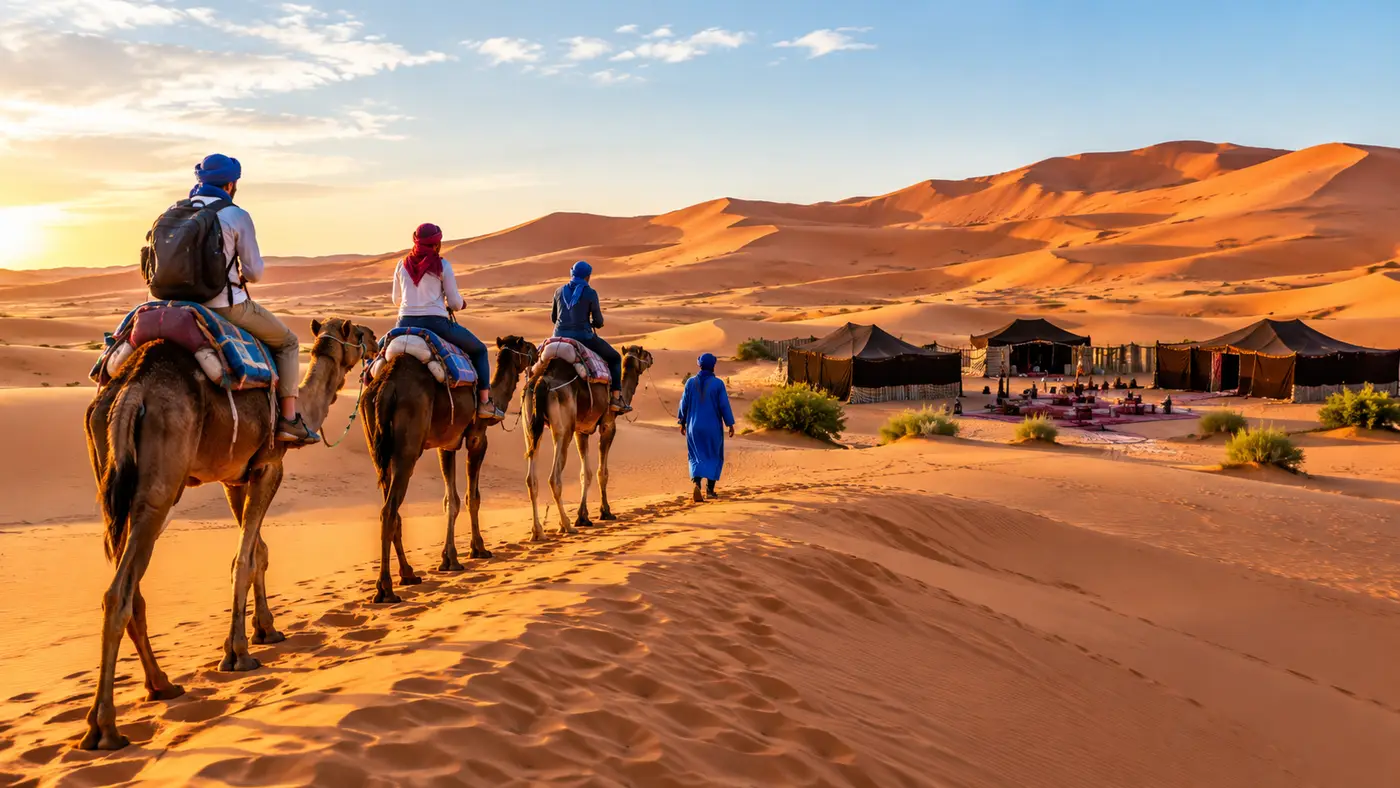
Nobody warns you about the squeak. As your dromedary stands up, hind legs first in a violent lurch that threatens to pitch you straight over its woolly ears, the wooden pack frame underneath the blanket lets out a loud groan. Then the front legs unfold. You are suddenly eight feet off the ground, staring at an ocean of apricot sand while the cool morning air bites your wrists. Booking a sahara desert camel tour is something almost everyone plans for their Moroccan itinerary, but few people realize how physically strange, deeply quiet, and surprisingly cold the desert actually gets once the sun drops behind the dunes.
Getting out into the deep sand requires some commitment. The Sahara is not right outside the airport gates in Marrakech or Fes. You spend long hours winding past terraced walnut groves, dry riverbeds, and ancient fortified granaries before the road gives way to dirt tracks. Whether you want a rugged multi-day hike leading a pack animal or an easy sunset ride to a Berber camp, understanding what happens out there makes all the difference between a miserable sore back and the best night of your life.
Book your sahara desert tours experience:
Riding Camels in Erg Chebbi: What It Really Feels Like
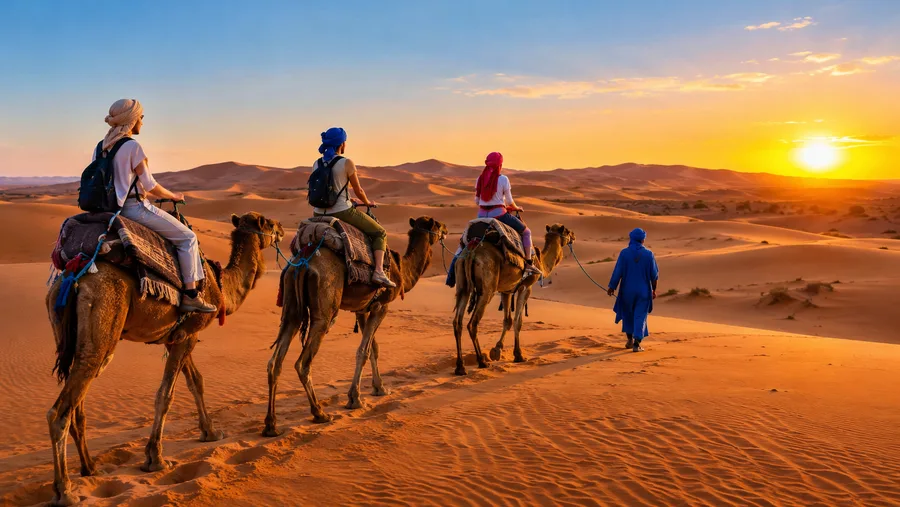
Camels do not trot. They pace, which means both legs on one side move forward together. This creates an odd, rolling rhythm that shifts your ribcage left to right. For the first twenty minutes, it feels relaxing. You sway to the muffled clop of hooves sinking into soft drift sand. Your guide, usually a local Amazigh youth in faded jeans and an indigo cheche wrapped around his face, walks barefoot or in plastic sandals, whistling quietly to keep the lead animal moving.
After an hour, your hip flexors start talking to you. The wooden saddles used across Morocco are wide. They spread your thighs apart across a thick padded blanket tied with rough nylon rope. If you have tight hips, you will feel it by kilometer three. Most afternoon rides into the Merzouga dunes at Erg Chebbi run about ninety minutes, which is just enough time to reach the interior camps before dusk without leaving you unable to walk.
Pro tip: Wear seamless cycling shorts under your loose hiking pants. The coarse wool blankets covering the pack saddles rub hard against your inner thighs after two hours of steady swaying.
Dismounting is another sudden ordeal. Camels drop front knees first with an abrupt thump. You lean back as far as your spine allows, grab the metal grab-handle, and brace your toes. Once your boots hit the sand, the stillness of the desert rushes in. The wind makes a soft hissing sound against the slip faces of the ridge. The smell of cedar smoke drifts over from the cook tent, mixing with the damp scent of resting beasts.
I think people romanticize Lawrence of Arabia a bit too much before their trip. You will get dust in your teeth. Your hair will feel gritty for three showers afterward. But watching long blue shadows stretch miles across the ridges as the sun turns from brass to deep blood orange makes every bruised muscle feel completely trivial.
Choosing Between Basic and Luxury Sahara Desert Camping Tours
Desert lodging ranges from a scratchy wool blanket tossed on the sand to carpeted hotel rooms hidden inside canvas walls. When looking at sahara desert camping tours, you have to decide how much comfort you need to sleep well. Traditional bivouacs are bare bones. You sleep in low goat-hair tents pitched in a horseshoe shape to block the drift. The mattresses sit right on the ground, laid over woven reed mats. There is often a shared squat toilet behind a dune, a single solar lamp, and buckets of well water to wash your face.
Luxury setups have changed the desert landscape completely. Glamping camps out by Erg Chigaga or near Merzouga feature high-ceilinged canvas suites with real wooden beds, king mattresses, and en-suite porcelain flush toilets. Generators or battery banks run power until 11 PM so you can charge your camera batteries, and hot water trickles out of shower heads piped from nearby tanks. It feels slightly surreal to take a warm shower while looking through a mesh window at three-hundred-foot sand hills.
| Camp Style | Average Cost (per night) | Bathroom Facilities | Comfort Level | Best Suited For |
|---|---|---|---|---|
| Standard Bivouac | $35 - $60 | Shared dry toilet or pit | Mattress on ground, thick blankets | Backpackers, minimalists |
| Mid-Range Camp | $75 - $130 | Shared flush toilet, basic shower | Raised metal beds, solar light | Independent couples, small groups |
| Luxury Glamping | $180 - $420 | Private en-suite, running hot water | Plush king beds, rugs, armchairs | Comfort seekers, honeymooners |
| Wild Nomadic Trek | $90 - $150 | Open wilderness (trowel provided) | Inflatable pads under the open stars | Adventurers, long-distance hikers |
Meals in the camps are surprisingly reliable. Even basic sahara desert camping tour operators serve a hot vegetable tagine, a bowl of spiced harira soup, and fresh round bread baked that afternoon in town. In the luxury setups, expect multi-course meals featuring slow-cooked lamb with prunes, almond briouats, and cold Moroccan wine if you arranged it beforehand. After dinner, the staff always builds a fire from dried tamarisk roots. Everyone sits around the embers listening to syncopated polyrhythms played on goat-skin drums, talking in hushed tones beneath an overwhelming canopy of stars.
A sahara desert overnight tour gives you a brief taste, but staying two nights changes the rhythm entirely. On a single-night run, you arrive at dusk, sleep, ride back at dawn, and leave in a van. Two nights lets you spend the middle day reading under an awning, hiking empty ridges, or walking to an abandoned lead mine without rushing anywhere.
Epic Routes: From High Peaks to Sand Ridges
You cannot separate the desert from the mountains that make it dry. Moist air off the Atlantic dumps rain on the western slopes of the High Atlas, leaving the eastern fringes parched. This geographical quirk makes combining high-altitude trekking with desert sand one of the most rewarding journeys in North Africa. Many travelers choose an atlas mountains and sahara desert tour, tracing the switchbacks of the Tizi n'Tichka pass down to the red earth valleys of the south.
Starting out from Marrakech, the classic Marrakech to Sahara desert route takes at least three full days of travel. The drive covers roughly 560 kilometers each way. You climb past walnut groves up to 2,260 meters before dropping into the Ounila Valley, where crumbling mud kasbahs stand against red limestone walls. If you have extra time and strong legs, joining a mount toubkal trek and sahara desert tour lets you summit the highest peak in North Africa at 4,167 meters before heading down into the furnace of the desert plain. Going from crampons on hard mountain snow to barefoot sand climbing within 48 hours is quite a jolt to the system.
Note: Winter nights drop below freezing in both the mountains and the dunes. Between December and February, sand temperatures inside non-heated tents hover around 3 degrees Celsius, so bring thermal base layers regardless of how warm the midday sun feels.
Erg Chebbi is the accessible choice. Paved roads run straight to the edge of the dunes at Merzouga, making it straightforward to reach even on tighter timelines. Erg Chigaga, located further southwest past the outpost town of M'Hamid El Ghizlane, requires two hours of hard 4x4 driving over rocky reg and dried lakebeds just to reach the sand. Chigaga feels far wilder, untamed, and noticeably less crowded.
Book your sahara desert tours experience:
Beyond the Saddle: Exciting Things to Do in the Sahara Desert
Dune fields look uniform from a distance, but the landscape holds more variety than expected. Finding good things to do in the sahara desert mostly comes down to how much sand you are willing to get inside your shoes. Sandboarding is popular in the late afternoon. Camp hosts keep wooden snowboards with makeshift foot straps propped against the dining tent. Waxing the bottom with candle paraffin helps the board slide down 40-degree faces. Climbing back up carrying a nine-pound piece of plywood, however, will empty your lungs in about four minutes flat.
For high-speed kicks, a sahara desert motorcycle tour or an afternoon buggy rental offers an entirely different pulse. Small groups on 450cc dirt bikes navigate the flat gravel plains separating the dune cordons, cutting through dried river washes where acacia trees cling to underground water pockets. The sound of four-stroke engines breaks the quiet, but hitting forty miles per hour over hard-packed clay flats gives you an incredible sense of scale.
Younger travelers often gravitate toward an 18-35s sahara desert tour. These trips bundle camel rides with night-time drum circles, group sandboarding sessions, and sunrise hikes, usually moving at a faster pace with cheaper group dorm tents. It gets social, noisy, and quite fun around the bonfire when fifteen people from six continents try to dance on deep sand.
If you prefer quiet over horsepower, pack a headlamp with a red-light mode and walk two hundred yards away from your camp lanterns around midnight. The silence is heavy, almost physical. The Saharan sky reveals the full sweep of the Milky Way with zero light pollution, crisp enough to spot satellites tumbling across constellations without binoculars.
- Light hiking boots or trail runners: fine sand destroys heavy leather, but burning mid-afternoon heat requires thick rubber soles.
- Cotton shemagh scarf: cheap, wide, and essential for blocking sand when gusts kick up dust devil spirals.
- Sturdy power bank: cold night air drains lithium smartphone batteries surprisingly fast in unheated tents.
- Wet wipes and eye drops: desert wind dries out contact lenses rapidly and camp wash water can be scarce.
- Wide-brimmed canvas hat: neck protection is mandatory when riding midday under direct sun.
Planning Morocco Sahara Desert Camel Trekking Tours
A successful desert journey hinges entirely on timing. Between late May and September, daytime temperatures regularly hit 45 degrees Celsius. Camels do not mind, but humans suffer heat exhaustion fast. The best months for morocco sahara desert camel trekking tours run from October through April. Autumn brings golden, mellow light and pleasant daytime warmth, while winter offers crystal clear blue skies alongside bone-chilling nights.
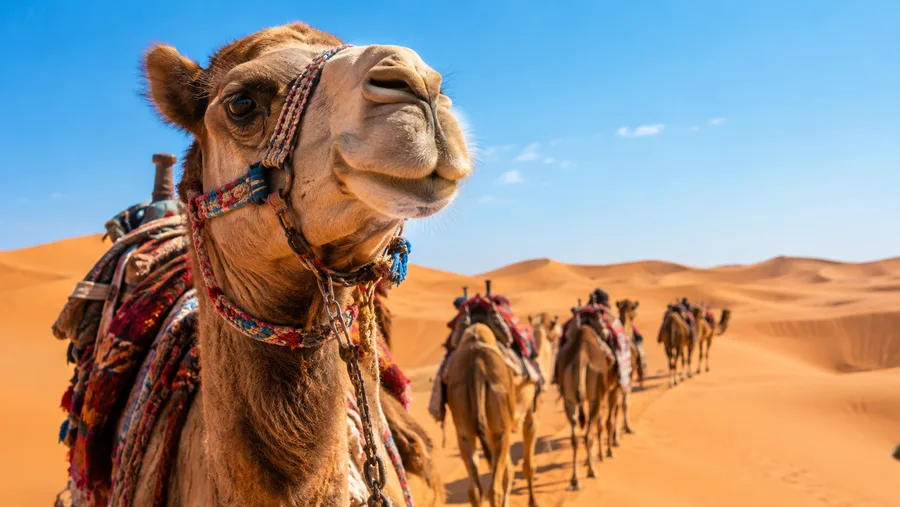
Picking an ethical operator matters. Look at how the animals are handled before handing over cash. A healthy camel holds its head high, carries an alert eye, and shows no raw saddle sores along its flanks or under the girth strap. Good camel drivers do not strike the animals across the snout with sticks; they communicate through throat clicks, guttural murmurs, and gentle tugs on the halter rope. Ask questions before you book.
- Confirm the trek duration: check if the camel trek is a genuine two-hour journey or a twenty-minute photo shoot near a parking lot.
- Inquire about bag transport: reputable outfitters haul large duffels into camp by 4x4, letting you ride carrying only a small daypack.
- Clarify camp location: ensure the camp sits deep inside the dune field, not right behind a roadside concrete hotel.
- Check dietary inclusion: verify drinking water is provided in sufficient volume, especially on long multi-day treks.
Organizing self-guided sahara desert camel tours upon arrival in Merzouga or Zagora is possible, but booking ahead saves immense hassle. Walking into town off a bus means negotiating with dozens of touts competing for commission. Booking directly through an established, locally-owned cooperative ensures your money goes to the families living in the surrounding oases, rather than middlemen working out of shopfronts in central Marrakech.
Frequently Asked Questions about sahara desert camel tour
Is camel riding difficult or uncomfortable?
It requires zero experience, but your inner thighs and hips will feel sore after forty-five minutes. Camels have a wide, rolling gait. Wearing stretchy pants and holding the saddle horn makes the ride manageable for most fitness levels.
What should I pack for an overnight desert trip?
Bring a warm fleece, thermal layers for winter nights, a windbreaker, eye drops, sunscreen, a headlamp, and a cotton turban scarf. Keep luggage minimal; pack small daypacks for the camel ride while main suitcases stay locked in vehicles or base hotels.
Can children and seniors participate safely?
Yes, children over five can easily ride with an adult or on their own docile camel led by a walking guide. For travelers with back problems or limited mobility, camps can arrange 4x4 jeep transfers directly to the tents instead of camel rides.
Quick Reference
- Erg Chebbi dunes reach up to 150 meters high
- Standard camel rides last between 60 and 90 minutes
- Night temperatures drop by as much as 20 degrees Celsius
- Peak season runs from October through April
- Luggage travels by support 4x4, not on your riding camel
Book your sahara desert tours experience:
The Bottom Line
The Sahara leaves a strange mark on you. Days after shaking red dust out of your shoes, you will catch yourself thinking about the immense quiet of the sand dunes and the clinking rhythm of camel stirrups. It is dirty, exhausting, and occasionally uncomfortable, but watching the sunrise paint the sand ridges pink makes every bump along the road worth it. Pack an open mind, extra warm socks, and let the desert set its own pace.
Read more about sahara desert tours.