Marrakech to Sahara Desert Tour: 3-Day Merzouga Itinerary Guide
Marrakech is loud, crowded, and smells like diesel exhaust mixed with crushed mint. When you book a sahara desert tour from marrakech, you trade that sensory riot for something completely different, though getting there requires serious patience. Erg Chebbi is not just around the corner. It sits 560 kilometers away across a mountain range and miles of barren stone plateau, tucked right against the Algerian border.
Most travelers pick the classic 3 days tour from marrakech to merzouga because it fits neatly into a week-long Moroccan vacation. It is an exhausting trip, honestly. You will spend around twenty hours in a vehicle over seventy-two hours, but watching the sunrise over 150-meter orange dunes makes you forget the cramped knees and switchback roads. This guide covers the route blow-by-blow, with zero sugarcoating about the drive times or the roadside tourist traps.
Book your sahara desert tours experience:
The High Atlas and Ait Benhaddou: Day 1 on a Marrakech Sahara Desert Tour
Your driver will likely knock on your riad door around 7:15 AM. Packing your bags out through the maze of the medina while the alleys are still slick from morning wash-down is cold and quiet. Once the van clears the perimeter road, you start climbing south toward the High Atlas mountains along the N9 national highway. The asphalt here was widened over the past decade, yet it remains a dizzying engineering feat. You climb through barren red dirt hills dotted with scraggly argan scrub before hitting the alpine hairpin turns below Tizi n'Tichka pass, which tops out at 2,260 meters elevation.
Note: Motion sickness pills are worth every penny here. The pass has dozens of continuous hairpin turns, and local drivers rarely brake early for descending gravel trucks.
Snow often dusts the summits between November and April. The air turns cold enough to see your breath at the top lookout, where tourist vans fight for parking beside stalls selling raw amethyst and dyed geodes. Skip the rocks. Walk twenty paces away from the stalls and take a look south toward the pre-Sahara valley. The topography drops abruptly into dusty clay canyon beds. It feels like another continent altogether.
By lunchtime, the tour hits Ait Benhaddou. This fortified clay village (ksar) has stood along the ancient salt caravan route since roughly the eleventh century. It was built from straw, mud, and river stones, which means it constantly erodes and requires ongoing patching after winter rains. Hollywood loves this place. Gladiator, The Mummy, and Game of Thrones were filmed here. Most tours dump you into an overpriced tourist cafe on the new side of the river for a dry 120-dirham tagine. If your guide allows free time, cross the stepping stones across the shallow Ounila riverbed on your own. Wander the empty upper alleys of the old ksar up to the ruined granary at the crest. The view across the surrounding stone desert is spectacular.
The late afternoon drive carries you past Ouarzazate, through the Valley of Roses, and into the Dades Gorge. Shadows fall fast behind the limestone ridges around 6:00 PM. You spend night one in a small valley guesthouse where stone walls trap the mountain chill, eating vegetable couscous beside an open fireplace.
Dades Gorge to Erg Chebbi: Day 2 of the 3-Day Desert Tour from Marrakech to Merzouga
The second morning starts with crisp mountain air and sweet mint tea before an 8:00 AM departure. The road follows the southern spine of the Atlas toward Tinghir, a sprawling oasis town fed by mountain runoff where green date palms cut through rust-colored bedrock. Just north of town lies Todra Gorge, a limestone canyon that narrows down to barely thirty meters wide with sheer vertical walls rising 300 meters above the shallow riverbed.
Tour groups usually spend forty minutes walking the paved strip through the gorge. Rock climbers camp out here for weeks, clinging to sheer routes above the freezing stream. Watch out for vendors trying to wrap scarves around your neck or push carpets into your hands. A polite, firm "La, Shukran" keeps them moving.
Pro tip: Pick up a four-meter cotton turban in Tinghir or Erfoud for roughly 60 dirhams. Desert guides will tie it properly for you, and it protects your face from blowing grit far better than any bandana or sunhat.
Past Tinghir, the landscape flattens out into the black gravel plains of the hammada. This is where many first-time visitors get confused. They expect sweeping yellow sand immediately, but Morocco's real desert is mostly sharp shale, dried mud, and low acacia bushes. Towns like Tinjdad and Erfoud pass by in a haze of midday dust. Erfoud is famous for marine fossils, and you will see dozens of roadside marble factories cutting trilobites and ammonites out of local limestone slabs.
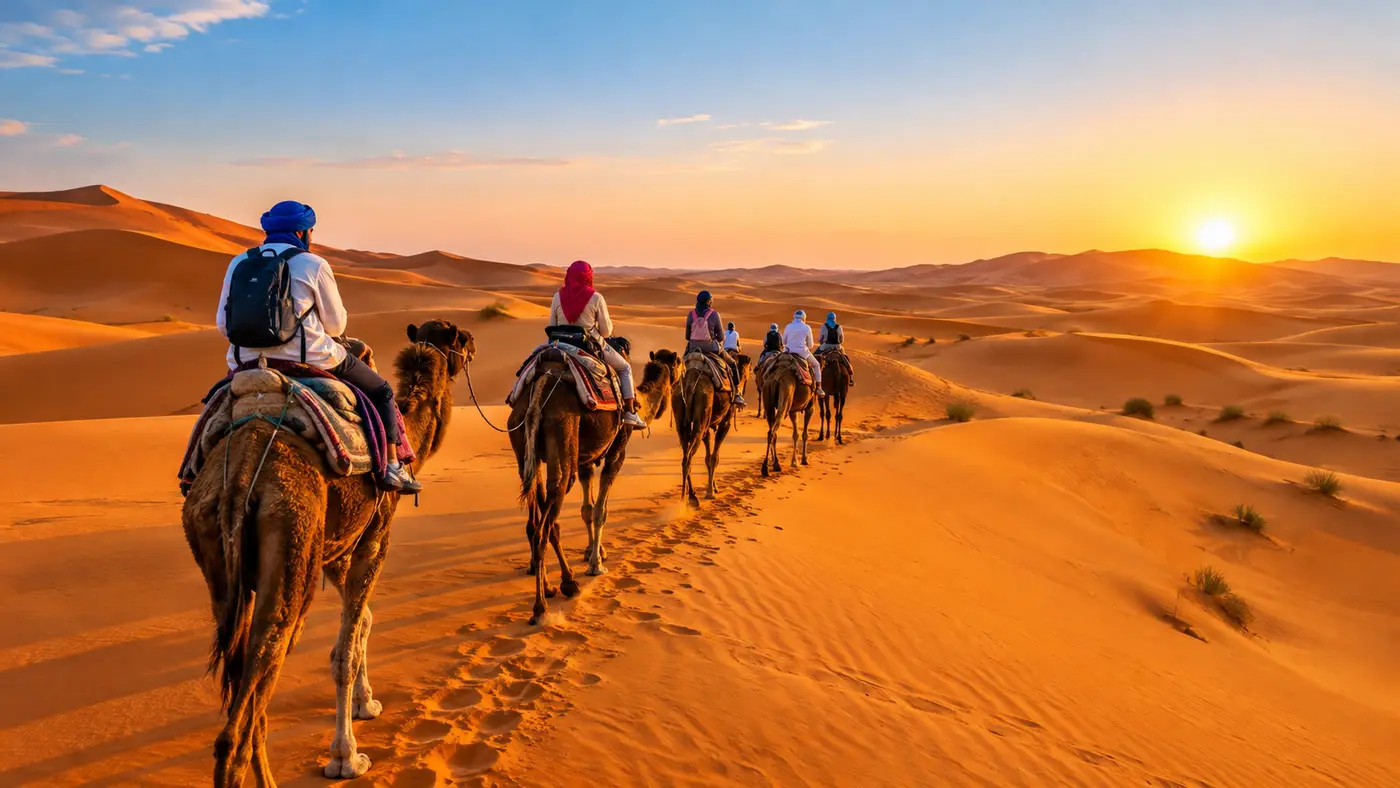
Around 4:30 PM, the black horizon changes. Far in the distance, towering apricot-colored waves rise straight out of the flat dirt plain. That is Erg Chebbi. The vans pull up to small staging auberges on the outskirts of Merzouga or Hassilabied. Here, you repack into a small daypack, leaving heavy rolling suitcases behind in the luggage room. You mount your assigned camel just as the afternoon heat breaks, riding single-file into the dunes for an hour while the shadows stretch out for hundreds of yards across the ridges.
Night in the Dunes and the Long Push Back: Day 3
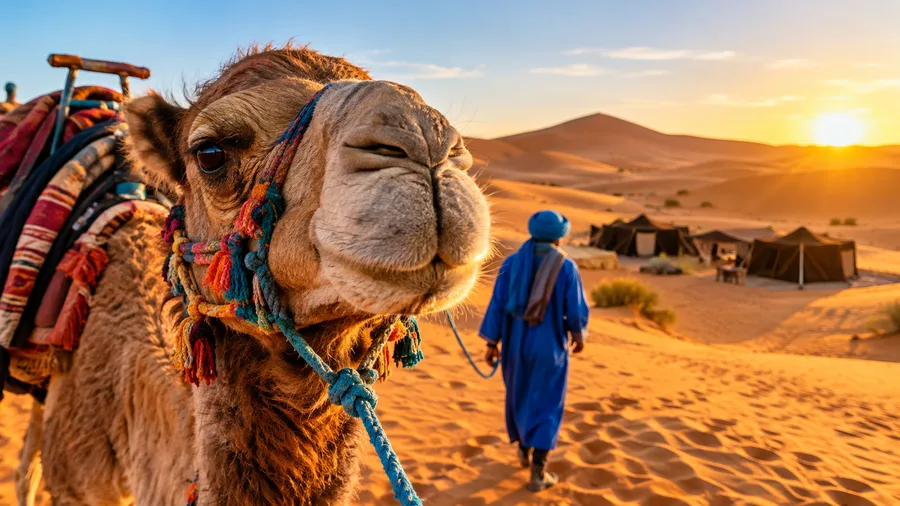
Sleeping in Erg Chebbi depends heavily on your booking style. Standard camps consist of wool-fabric nomad tents grouped around a central rug-lined courtyard, often with shared pit toilets and cold water buckets twenty paces away. Luxury camps feature raised wooden platforms, canvas safari tents, private en-suite flush toilets, and hot water showers running off massive solar batteries. After dinner, camp workers build a small tamarisk-wood fire, playing metal qraqeb castanets and handheld Berber drums under a ridiculous canopy of stars.
The silence out there is heavy. Walk five minutes away from the camp lamps and the dark swallows everything. Just remember which dune ridge you walked over, because every sand bowl looks identical once your eyes adjust to the starlight.
Day three is a test of endurance. Camp wake-up is early, usually 5:30 AM, so you can climb the nearest ridge to watch the sun ignite the dunes in bright red and amber. You ride the camels back to the base hotel for a quick breakfast, rinse the fine dust off your hands, and climb into the van by 8:00 AM. If you are doing a loop back to your starting point, you face a 560-kilometer haul over nine to ten hours. The driver will take a southern route through Rissani, Alnif, and Nkob before rejoining the mountain highway past Ouarzazate.
You can avoid repeating the mountain crossing if your travel plans allow it. Many travelers opt to finish your desert tour in Fes instead of heading back west. That route heads north through the Ziz Valley gorge and the cedar forests of Azrou, cutting your final day drive down to about seven hours and depositing you in Morocco's oldest imperial city by evening.
Book your sahara desert tours experience:
Shared vs Private Sahara Desert Tours from Marrakech
You will see hundreds of identical sandwich boards in the alleys around Jemaa el-Fna offering a 3 day sahara desert tour from marrakech for bargain basement rates. Picking between a shared minibus and a private 4x4 comes down to your budget and how much you value personal space.
Shared tours pack fourteen to seventeen passengers into a Mercedes Sprinter van. You do not control the stops, the playlist, or the timing. If someone in row three gets car-sick, everyone waits. If the driver has an arrangement with an expensive tourist restaurant, you eat there whether you like the food or not. However, for solo travelers and backpackers, it is cheap and offers instant social company.
Private trips cost considerably more, but you travel in a Toyota Prado or Land Cruiser with your own driver. You can stop whenever you spot a ruined kasbah, skip the rug demonstrations entirely, and leave thirty minutes early to beat the convoy of minibuses to the canyon lookouts.
| Tour Type | Average Cost per Person | Transport Vehicle | Camp Quality | Ideal For |
|---|---|---|---|---|
| Budget Shared | €90 - €130 | 14-17 seat minibus | Basic nomad tent, shared outdoor bath | Solo travelers, backpackers on a tight budget |
| Standard Private | €240 - €340 (pair) | Comfortable 4x4 / minivan | Private tent, shared clean facilities | Couples wanting autonomy and flexible stops |
| Luxury Private | €420 - €650 (pair) | High-end 4x4 (air-conditioned) | Deluxe glamping, en-suite bathroom, electricity | Honeymooners, photographers, comfort seekers |
Essential Packing Advice for a Desert Trip from Marrakech
Packing for three days in the desert sounds straightforward, but extreme temperature shifts catch people completely off guard. The Sahara can easily push 38°C (100°F) in the afternoon sun and drop to 4°C (39°F) eight hours later if you travel between late October and March. Dress in loose, breathable layers you can shed throughout the day.
Before packing your daypack, review our detailed guide to Moroccan desert costs and clothing to make sure you have the basics dialed in. Here are the non-negotiables for your Erg Chebbi carry-on bag:
- Warm fleece or down jacket: necessary between November and March, as desert tents have zero insulation against the nighttime drop.
- External power bank: essential because standard desert camps run on limited solar power and outlets are often nonexistent inside standard tents.
- Wet wipes and eye drops: indispensable for clearing the fine, powdery silica sand out of your eyelashes and off your skin before sleeping.
- Small cash bills: critical for roadside bathroom tips (usually two dirhams), camel handlers, and tipping your driver at the end of day three.
- Zip-top plastic freezer bags: keep your smartphone and camera gear completely sealed when the wind kicks up sand on the dunes.
Roadside infrastructure along the N9 and N10 routes has improved recently, but you should still manage your expectations regarding rest stops and amenities. Keep these daily realities in mind while crossing the interior provinces:
- Restroom conditions: roadside cafes between Ouarzazate and Tinghir often feature squat toilets with basic rinse buckets instead of toilet paper.
- Bottled water supplies: buy two five-liter jugs in Ouarzazate on day one because small shops near the dunes mark water up significantly.
- Tipping expectations: budgeting roughly 150 to 200 dirhams total per day for your driver is standard practice for solid driving and good local navigation.
- Coerced shopping stops: guides routinely stop at women's rose water cooperatives and Berber carpet houses; you are never obligated to buy anything.
Frequently Asked Questions about sahara desert tour from marrakech
How long is the actual driving time from Marrakech to Merzouga?
The total driving distance is approximately 560 kilometers each way. Day one takes about seven hours behind the wheel. Day two involves five hours of driving, and the return trip on day three takes around nine to ten hours depending on mountain traffic and meal breaks.
Is Zagora better than Merzouga for a short desert trip?
Zagora is closer and works for a 2-day trip, but it is a rocky flat plain with small sand patches rather than towering dunes. Merzouga has the massive Erg Chebbi dunes that match what most people picture when they imagine the Sahara. If you want real dunes, Merzouga is worth the extra day.
Are there electricity and hot showers in the desert camps?
Standard budget camps typically have central solar lamps and shared cold water taps, with no plugs inside private tents. Luxury camps have private bathrooms with solar-heated hot water showers, flushing toilets, and running electricity for charging phones inside the tent.
What is the best month to do a desert tour from Marrakech?
October, November, March, and April offer the most comfortable weather. Midsummer (July and August) brings blistering heat exceeding 45°C (113°F) that makes the midday drive miserable, while January nights routinely drop near freezing in the sand.
Quick Reference
- Total driving distance: 1,120 km round-trip
- Primary destination: Erg Chebbi dunes near Merzouga
- Average shared tour price: €90 to €130
- High pass elevation: 2,260 meters at Tizi n'Tichka
Book your sahara desert tours experience:
Is It Worth It?
Three days cooped up inside a van along winding mountain roads is demanding on the body. You will eat mediocre tagines at highway rest spots and spend long stretches staring at dry stone hills out of a dusty window. But when you climb to the crest of Erg Chebbi, barefoot on cold sand, watching the horizon turn violet as dusk settles over the Sahara, you realize why thousands of travelers make this journey every single week. Book with a reputable operator, pack warm layers, keep some cash handy, and prepare for one of the most memorable road trips anywhere in North Africa.
Read more about sahara desert tours.